
When the Past Echoes Back
On the strange familiarity of histories we never lived.

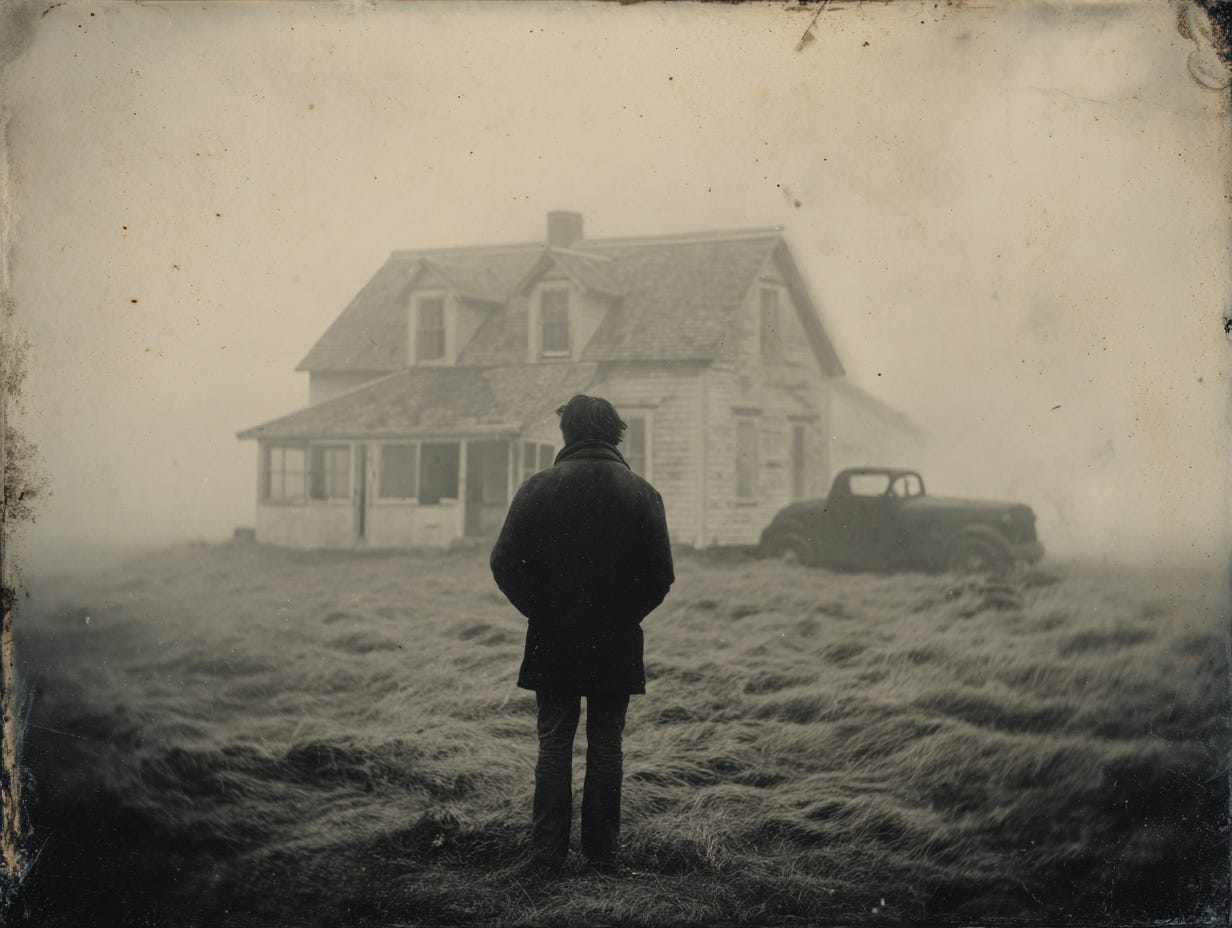
Is there a period of history you feel strangely connected to, despite having never lived through it?
For me, it’s the Dust Bowl era. Ah, the Great Plains of the 1930s. A time of collapse without spectacle. Hard land. Hard weather. Families staying put long after the logic of leaving had made itself clear.
I have no clean explanation for why this period has always pulled at me.
Ken Burns’ Dust Bowl documentary has been streamed in my home more times than I can count. I loved Carnivàle when it aired on HBO, not just for its mysticism but for its texture, its grit, the way survival itself felt like the primary narrative. I’m drawn to the workwear of that era, the practical beauty of clothes built to endure weather and labor, which is probably why I find myself buying deadstock vintage from obscure eBay sellers and when I’m feeling fancier, shopping at places like RRL without fully knowing why. Something about that time speaks to me in a register below our everyday language.
It’s not nostalgia. I don’t romanticize it. The suffering was real. The systems failed. The land itself turned hostile. And yet, beneath the devastation, there was dignity. People endured without narrative cover. They rebuilt without being told they were heroic. They didn’t perform resilience. They lived it.
For years, I chalked this attraction up to aesthetic preference or historical curiosity. But recently, I came across a Japanese concept that gave the feeling a name.
Genshūkei.
Roughly translated, it refers to an original landscape. Not the place you were born, but a place that feels foundational to your inner world. A scene, environment, or era that carries a sense of emotional familiarity despite no direct lived experience. It’s that lonesome ache of recognition, the pang you get when you encounter something that feels like home, even if you’ve never been there.
Genshūkei emerges from Japanese aesthetic philosophy, particularly ideas rooted in mono no aware (often described as a sensitivity to the fleeting nature of things, sometimes translated as the “ah-ness” of life’s passing moments) and the subtle emotional resonance of impermanence. It reflects a sensitivity to atmosphere, to memory that may not be personal but still feels intimate. In Japanese literature and psychology, this concept often appears when describing why certain landscapes or moments stir something deep and unnameable within us. A rural road at dusk. A field after harvest. A town half emptied by time.
It’s not about longing for the past. It’s about recognizing something essential that words struggle to describe.
Modern psychology doesn’t talk about genshūkei explicitly, but it circles the same terrain. Carl Jung wrote about the collective unconscious and archetypal memory, the idea that certain images and patterns live within us not because we experienced them directly, but because they are part of the long arc of our shared human story. Developmental psychologists have explored how people can feel emotional attachment to historical narratives or environments that mirror internal states. Trauma research notes how individuals are often drawn to stories of endurance, collapse, and rebuilding during periods of personal transition, even if the stories are not autobiographical.
I feel seen.
There is also emerging research in neuroscience suggesting that the brain does not strictly differentiate between lived memory and vividly imagined or culturally absorbed memory. What we repeatedly attend to, what we emotionally encode, becomes part of our internal landscape regardless of origin.
And then there is physics.
In 2022, the Nobel Prize in Physics was awarded to researchers Alain Aspect, John Clauser, and Anton Zeilinger for experiments on quantum entanglement. Their work demonstrated that particles can remain connected across vast distances in ways that defy classical notions of locality. While this research is not about consciousness or memory directly, it has reignited broader scientific conversations about nonlocality, interconnectedness, and the limits of linear causality.
Said another way, just because you’re separated by time and distance doesn’t alone disassociate you from connection.
Some theorists have speculated, cautiously, about multiverse frameworks, the idea that multiple possible timelines or realities may coexist. This is not science fiction, but speculative physics, grounded in mathematical models rather than experiential claims. There is no empirical evidence that humans consciously perceive alternate timelines, but there is an increasing recognition that reality may be far stranger and more layered than our everyday experience suggests.
Thank the gods.
This essay isn’t here to say I lived another life in the Dust Bowl era. I don’t need that explanation. What interests me more is the possibility that we are sensitive to patterns that rhyme with our current moments. That when structures we’ve relied on fail, when facades give way to illusion, when our lives get so chaotically stirred up that sheer endurance becomes de rigueur, we humans are compelled by stories and landscapes that, in subtle, hopeful ways, have already walked the road we’re on.
Lately, my life has been marked by transitions. Professional identities shifting. Relationships changing shape. Old structures no longer holding. New ones not yet fully built. I’ve found myself thinking less about ambition and more about consistency. Less about performance and more about durability. Less about speed and more about what can actually last.
What are the shifts you’re currently embracing and what are the ones you’re actively resisting?
The Dust Bowl was not a time of reinvention in the modern, Eat, Pray, Love sense. It was a time of reckoning. People didn’t “pivot”. They endured. They stayed close to the ground. They learned what mattered when excess was no longer available. They accepted life without guarantees.
That feels relevant now.
Perhaps these unexplained affinities are not about the past at all. Perhaps they’re signals. Invitations to pay attention to the lessons embedded in other times and places that mirror our own internal terrain. Maybe we are not haunted by other eras so much as sensing an invitation to be instructed by them.
I don’t know if we are living in multiple timelines simultaneously. I don’t know if memory can reach across realities. But I do know that there are moments when the veil feels thinner, when a song, a photograph, a landscape, or a historical period carries a static electric charge that I feel in my innards that cannot be explained by aesthetic preference alone.
Those moments are asking something of us.
Maybe they are reminders that others have stood where we are standing now, under different skies, with different names, facing the same essential questions. How to endure without becoming hard. How to rebuild without forgetting. How to live honestly when the ground shifts beneath your feet.
If we listen closely to these instincts, without needing to mythologize them or explain them away, perhaps we’ll find they carry the lessons we need most.
Not from another life.
But for this one.
Take good care,
MV
Loved this, Michael.
Beautifully written and just in time. TY.