

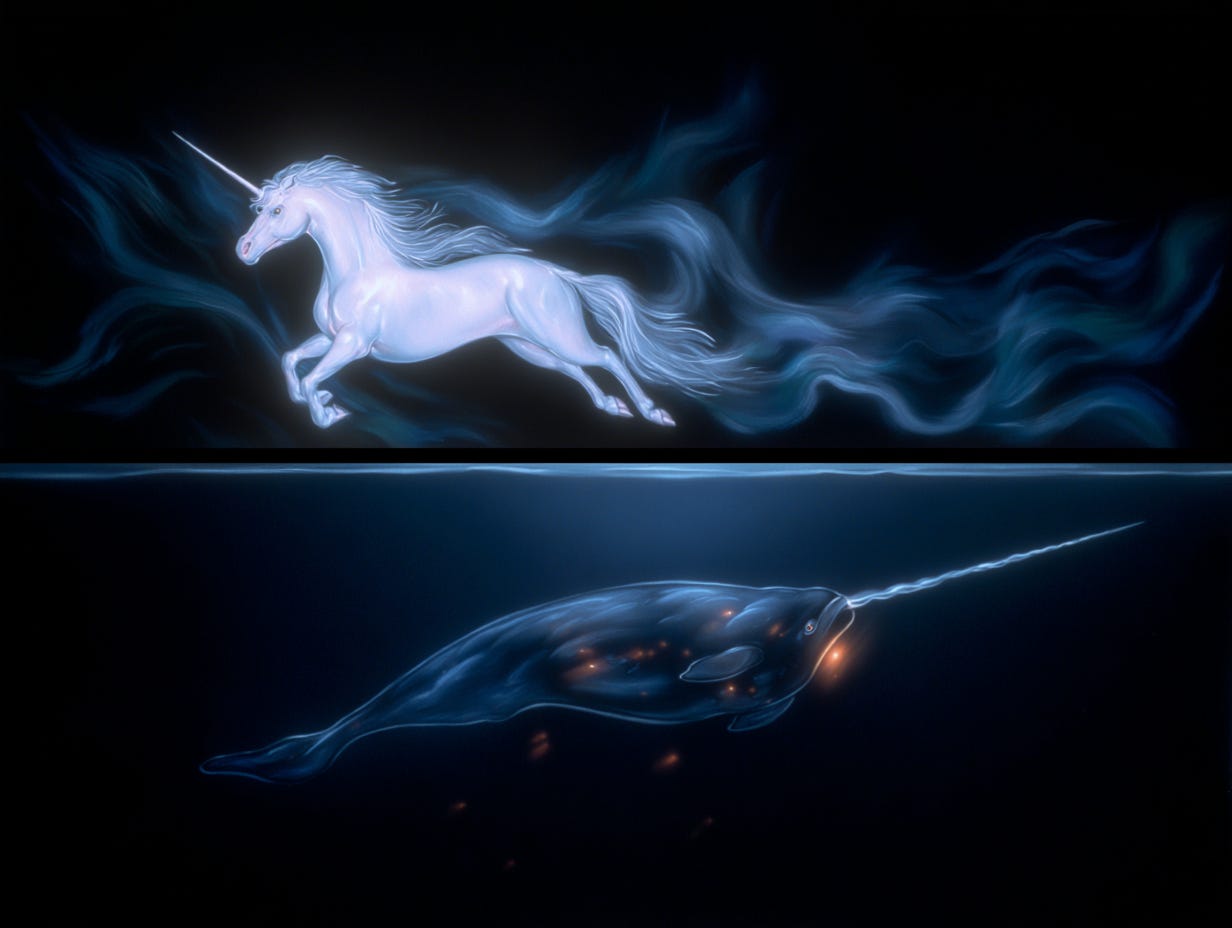
The startup world’s most celebrated aspiration is named after something that doesn’t exist. That turns out to be fitting.
The term “unicorn” entered the startup lexicon in 2013, coined by venture capitalist Aileen Lee to describe privately held companies valued at more than a billion dollars. The name was meant to signal rarity: something magical, almost impossible to find, a creature that exists in legend more than in life.
The irony is how quickly it stopped being rare. There are now more than 1,600 unicorns globally, over a thousand of them in the United States alone. The magic wore off somewhere around the five hundredth one. What didn’t wear off was the culture the name created: the belief that billion-dollar valuation is the right goal to organize a company around. The proof that the story you’re telling is true.
That belief has a mixed track record. WeWork peaked at a $47 billion valuation before investors looked at the books and found a real estate company dressed in tech clothing. Theranos (said in my best Elizabeth Holmes voice) reached $9 billion on the back of blood-testing technology that didn’t exist. Quibi raised $1.75 billion, launched in April 2020, and was gone by December of the same year. The list is long and includes companies that weren’t fraudulent, just fantastical, built around a vision of what they could become rather than what they actually were.
Roughly seventeen percent of unicorns end up overvalued or unviable. Researchers at Harvard estimate that as few as one in five high-growth tech companies that lose momentum ever recovers it. The probability of any startup reaching unicorn status in the first place is less than 1 percent. And yet the rarefied unicorn remains the organizing aspiration of the startup world, the vision that founders pitch and investors chase. It has become the goal, not the byproduct of building something genuinely good.
What the Unicorn Culture Actually Produces
The unicorn framework asks companies to optimize for valuation above nearly everything else. Valuation is, in the startup world, a future-tense number: it reflects what a company might become, not what it is today. Organizing a company around that number produces specific behaviors. The story runs ahead of the substance. Capability is projected before it exists. Founders and investors alike are incentivized to keep feeding the narrative rather than interrogating it.
WeWork’s Adam Neumann didn’t simply oversell his company. He built a culture entirely organized around the projection of a particular future, in which a co-working space would “elevate the world’s consciousness” and deserve the valuation of a transformational tech company. When the story met reality and investors preparing for an IPO actually examined the fundamentals, the gap was catastrophic. The company’s valuation dropped from $47 billion to under $9 billion before the IPO was pulled entirely.
The same behavior existed at Theranos, where Elizabeth Holmes maintained control through superhuman storytelling, structural governance that insulated her from scrutiny, and a board populated by people without the technical expertise to ask the right questions. The technology was never real. And the story was so good that it didn’t matter. Until it did.
These are extreme cases, but the pattern is real. It’s the ordinary consequence of a culture that prizes the appearance of potential over the reality of performance. The unicorn aspiration tells founders to reach for the fantastical, to be something mythological, to inspire awe. It rarely asks: what problem are you actually solving, for whom, and can the business self-sustain?
To be clear: some unicorns are real. Stripe built infrastructure that actually works at scale. Canva democratized design in ways that genuinely changed how people work. SpaceX did things that weren’t supposed to be possible. These companies reached enormous valuations because they built something the world needed and then delivered it. They are, in the language of this essay, narwhals that got labeled unicorns. The problem is not ambition or scale. The problem is a culture that has learned to perform those outcomes rather than produce them, and that has made the performance so rewarding that the production has become optional.
The animal that actually inspired the unicorn myth has been quietly living under Arctic sea ice for five million years. It doesn’t perform. It doesn’t advertise. It has outlasted nearly every predator, every market condition, every story ever told about it. We’ve been looking at the wrong animal.
The Narwhal
The narwhal is, technically, the animal that gave rise to the unicorn myth. Medieval traders sold narwhal tusks across Europe as unicorn horns, and the legend of the unicorn grew from there. Queen Elizabeth I reportedly paid the equivalent of £1.5 million for a single narwhal tusk. But the narwhal itself was never discovered by most of the people who told those stories, never seen, never understood. It lived somewhere below the surface, doing what it needed to do, indifferent to its own mythology.
The narwhal is a medium-sized Arctic whale. Its tusk, which can grow to ten feet and is actually a modified canine tooth filled with millions of nerve endings, is the source of enormous scientific debate. No one is fully certain what it’s for. Some researchers believe it plays a role in mating. Drone footage from 2016 revealed narwhals using their tusks to stun fish before eating them. The best current evidence suggests it functions primarily as a sensory organ, capable of detecting subtle changes in water temperature, pressure, and salinity in real time. The narwhal doesn’t imagine an environment. It reads the actual one.
The narwhal dives to depths of 1,500 meters, spending extended periods under sea ice in the harshest environment on the planet. Its physiology is engineered for exactly this: slow-twitch muscle fibers for endurance, myoglobin-rich tissue for storing oxygen, a cardiovascular system that shunts blood away from non-essential organs during a deep dive to preserve what matters. None of this is visible from the outside. None of it shows up in narwhal marketing (there is no narwhal marketing). All of it is why the narwhal is still here.
It lives in small pods, surfaces when it needs to, and has been doing its own thing for roughly five million years. It does not swim in circles at the top of the ocean reminding everyone it exists. It goes deep, does the work, and comes up for air when the work requires it. The pod is small enough to be managed, close enough to be trusted, clear about what it’s for. There is no narrative to maintain. There is no regular announcement cycle. There is only the dive, the surfacing, and the dive again.
It does not perform. It does not advertise. It is built for its reality, not an out of reach fantasy. And it has no interest in being mistaken for a unicorn. It knows what it is.
What Survives
Startup success statistics are often read as an argument for swinging big. If ninety percent of startups fail anyway, the reasoning goes, you might as well reach for the billion-dollar outcome. The expected value seems to favor it.
But the math ignores something. The companies that last, that build real value over time, that create durable products and relationships and organizations, tend not to be the ones that grew fastest or raised the most or told the most intoxicating stories. They tend to be the ones that understood their environment precisely, stayed honest about what they were, and built for the conditions that actually existed rather than the conditions that made for a better slide deck.
The companies that tend to survive that scrutiny share a recognizable profile. Patagonia spent decades building for the conditions it actually operated in, optimizing for product integrity and customer trust rather than valuation velocity, and is now worth roughly $3 billion with zero outside investors. Basecamp, now called 37signals, has been profitable for over twenty years without a single funding round, by staying small enough to remain true to its vision and refusing to mistake growth for health. Notion spent six years in relative silence before its product was ready for the world. Mailchimp bootstrapped to a $12 billion acquisition. These are not the companies that get celebrated at TechCrunch Disrupt. They are the companies that are still here.
The narwhal has been doing what it does for five million years. It surfaces when it needs to. It goes deep when the work requires it. It doesn’t care about bravado.
The unicorn is what you might become. The narwhal is how you get there.
Take care,
MV